Drainage correction in Hattiesburg runs $1,500–$6,000. With 59.17 inches of rain a year (NOAA/NCEI 1991–2020) over a formation MDOT lists among high-volume-change soils, controlling moisture at the foundation line is the cheapest intervention available — and it doubles as a diagnostic.
Why water is the lever on this ground, why the work should be targeted rather than ringed around the house, and how to read the result.
The material only moves when it gets wet
Clay of this kind is a sponge with opinions. Take on water and it grows; give it up and it contracts. Anything resting on it goes along for the ride, and the more violent the wet-to-dry swing, the longer the ride.
Rainfall here is generous enough to make that swing large, and the summer stretches between are dry enough to make it a genuine cycle rather than a steady state. So the single most effective thing a homeowner can do cheaply is reduce how sharply moisture changes right at the foundation line — which is a matter of where roof and surface water goes.
Target it, do not ring the house
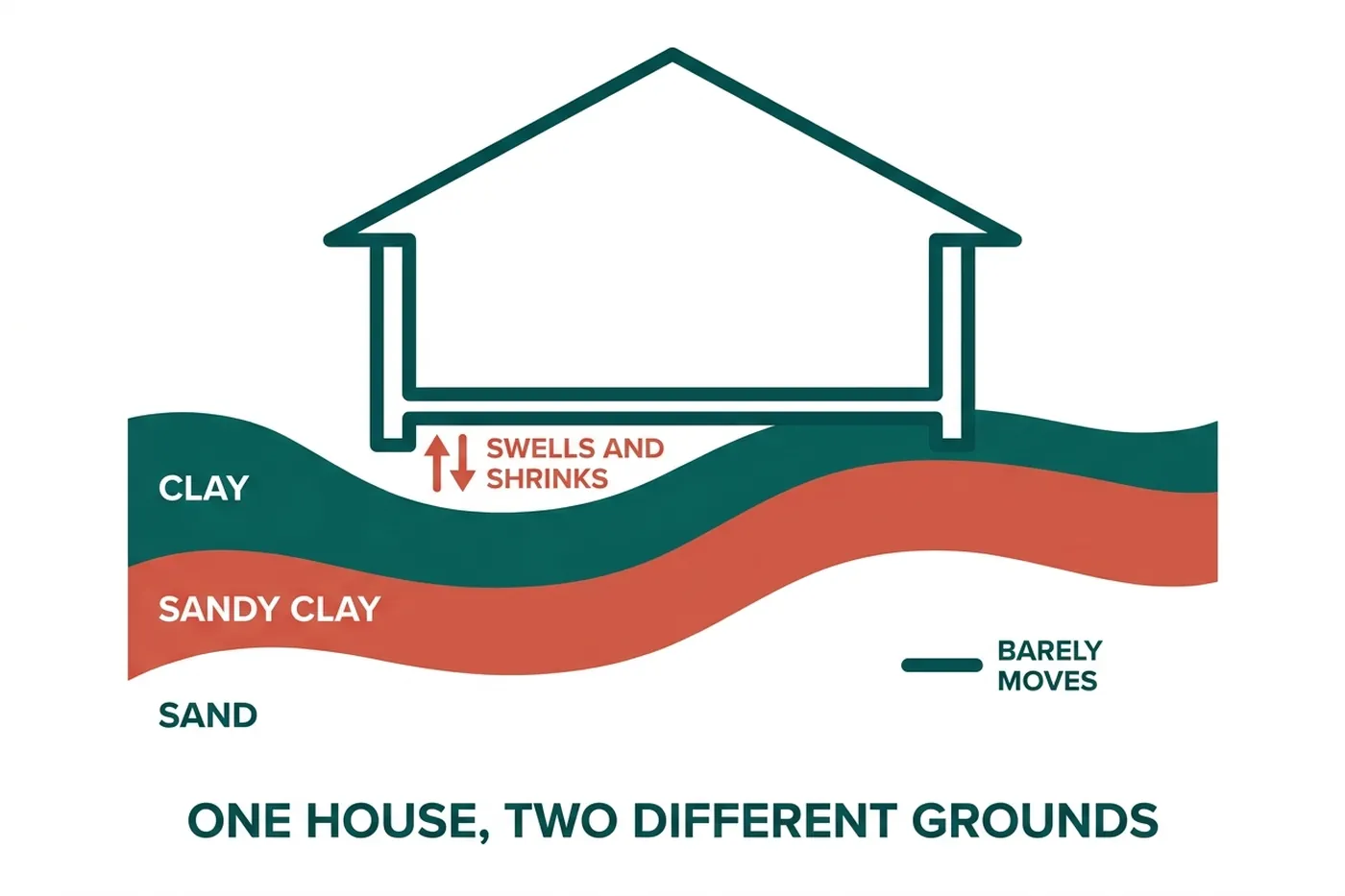
This is where the layered ground changes the advice. On uniform soil, perimeter drainage is reasonable everywhere. Here, if the contour shows movement confined to one elevation, the water management that matters is on that elevation.
Money spent ringing an entire house when one wall is the problem is money not spent on the wall. Take the survey first, then let the readings decide where the work goes — the same logic that governs where piers belong.
What the work involves
| Measure | What it addresses | Typical range |
|---|---|---|
| Downspout extensions | Roof water discharging at the foundation line | $150–$600 |
| Regrading the first ten feet | Ground falling back toward the house | $800–$2,500 |
| French drain, affected side only | Water arriving at the elevation that is moving | $2,000–$4,500 |
| Full perimeter system | Water standing against several sides | $4,000–$6,000 |
| Discharge relocation | A system currently emptying too close to the house | $500–$2,000 |
Where the pipe ends is the line most quotes leave vague. Collecting water perfectly and then letting it out a few steps from the house has not solved anything — it has shortened the journey the water makes back.
Where the water is actually coming from
Four sources, in rough order of how often they turn out to be the culprit here, and all four are checkable by the owner before anybody is paid.
| Source | How to spot it | Cost to correct |
|---|---|---|
| Roof discharge at the wall | Stand outside in rain and watch where downspouts empty | $150–$600 |
| Ground fallen back toward the house | Water pools against the foundation and stays after the rain stops | $800–$2,500 |
| A neighbour’s runoff crossing your lot | Water arrives from a direction your own roof cannot explain | Varies — often a diversion upstream |
| An irrigation line or tap leaking | One patch stays green or damp through a dry stretch | Plumbing repair only |
The third one is worth naming because homeowners rarely consider it and it is common on the flatter ground around Petal and Scott. Where the water starts on somebody else’s property the fix is still usually on yours, but knowing the origin changes what the fix has to do.
Reading the result
Survey the house before the diggers arrive, then again once a full wet season has run through. The second reading will show the movement halted, eased, or carried on regardless — and every one of those three results is worth what the drainage cost.
The third outcome is the valuable one, however unwelcome. It says the water was not the driver on that section, which redirects the next dollar toward support instead of toward more pipe. Most homeowners never get that answer because nobody took the first set of readings.
Drainage — asked and answered
What does drainage correction cost in Hattiesburg?
Expect $1,500-$6,000, set mostly by how far the water has to travel and what sits in its path. Longer downspouts and reshaping the ground are the cheap end. A French drain down the affected elevation, ending somewhere that genuinely falls away, is the top of it.
Why does drainage matter so much on this soil?
Because expansive layers only respond to water that reaches them. The Hattiesburg Formation is listed among high-volume-change soils, and 59.17 inches of annual rainfall gives it plenty to work with. Reducing how sharply moisture swings at the foundation line reduces how far the material moves.
Can drainage fix the problem on its own?
Where the contour is still close to flat and symptoms track rainfall, often yes - and it is a fraction of the cost of support. Where readings show a section has already dropped measurably, drainage stops it worsening but does not recover what was lost.
Does it matter that only part of my house is affected?
It matters for where the work goes. If the contour shows one wall dropping, that is the side where water management earns its money. Ringing an entire house with drainage when one elevation is the problem is a common way to spend the budget in the wrong place.
How long before I know if it worked?
Give it a full wet season and take elevation readings before and after. Three outcomes are all useful: movement stops, movement slows, movement continues unchanged. The third is the one that saves the most money, because it redirects you before more is spent on water.
Get a Hattiesburg elevation survey
Tell us which rooms are affected and which are not. On interbedded ground that contrast is the most useful thing you can give us — a house where the front is fine and the back bedroom is dropping is telling us something about what each end is sitting on. You get a call back from a local specialist who serves Hattiesburg.